Glossary

Androgen: a hormone, like testosterone, that causes the body to develop masculine characteristics..

Bone mineral density (BMD): a measurement of how thick and strong the bones in the body are.

Corticosteroids: medicines used to provide relief for inflamed areas of the body. They lessen swelling, redness, itching, and allergic reactions. They are often used as part of the treatment for a number of different diseases, such as severe allergies or skin problems, asthma, or arthritis. Corticosteroids may also be used for other conditions as determined by your doctor.

Diabetes: a condition characterized by too much blood glucose in the body. In type 1 diabetes, the pancreas no longer makes the hormone, insulin. When this happens, blood glucose cannot enter the cells to be used for energy. In type 2 diabetes, either the pancreas does not make enough insulin or the body is unable to use insulin correctly.

Drug interaction: certain medicines taken together may make your medicine less effective, cause unexpected side effects, or increase the action of one or more of the medicines. Be sure to tell your doctor about all of the medicines you are taking.

Erectile dysfunction (ED): the inability to achieve an erection all or some of the time, or the inability to sustain an erection.

Gynecomastia: enlarged breasts in men.

HDL: also known as high-density lipoprotein, this so-called good cholesterol is thought to protect against heart attack by carrying away buildup of cholesterol on artery walls.

Hormone: a chemical substance made in one part of the body that travels through the bloodstream and affects cells and tissues in another part of the body.

Hyperlipidemia : a higher than normal amount of fats or lipids in the blood. Hyperlipidemia is linked to high cholesterol and heart disease.

Hypertension: high blood pressure, usually defined as at least 140 mm Hg systolic pressure over 90 mm Hg diastolic pressure (140 over 90).

Hypogonadism: the medical condition caused by Low Testosterone (Low T), which means the body doesn't make enough testosterone; Low Testosterone may affect mood, muscle mass, bone mineral density, and sexual function.

Insulin: a hormone that helps the body use glucose for energy.

LDL: also known as low density lipoprotein, this is the so-called bad cholesterol that can clog those arteries that lead to the heart and the brain.

Low T: also known as Low Testosterone and can lead to a condition called hypogonadism, which means the body doesn't make enough testosterone; Low Testosterone may affect mood, muscle mass, bone mineral density, and sexual function.

Obese: defined as a BMI (body mass index) over 30 kg/m2. An adult male is considered obese when his weight is 20% or more over the maximum desirable for their height.

Osteoporosis: a condition marked by less than normal bone density. Low bone density can make bones brittle and increase the risk of breaking a bone.

Oxyphenbutazone: a medicine used to treat arthritis, gout, and similar conditions.

Pituitary gland: an endocrine gland suspended beneath the brain, supplying numerous hormones that control many vital processes. Some of the hormones it supplies that influence sexual function include follicle stimulating hormone and luteinizing hormone.

Propranolol: a medicine (beta-blocker) mostly used to treat high blood pressure.

Prostate specific antigen (PSA): a protein made by the cells of the prostate gland that can signal increased growth of the prostate. Doctors perform a PSA test to check for prostate disease.

Rheumatoid arthritis: chronic (long-term) disease that is characterized by inflammation of the joints and surrounding tissues.

Testosterone: a hormone that helps some of the body's organs work the way they should. It's one of the most important male sex hormones. Testosterone increases body and facial hair, deepens the voice, maintains sperm cell production, and controls sexual desire and function. Testosterone can also affect energy and mood.

Triglycerides: the chemical form in which most fat exists in food as well as in the body. Calories eaten and not used immediately for energy are converted to triglycerides and stored in cells for energy between meals.

If you have any questions about this information, be sure to discuss them with your doctor.

You are encouraged to report negative side effects of prescription drugs to the FDA. Visit www.fda.gov/medwatch or call 1-800-FDA-1088.

If you cannot afford your medication, visit www.pparx.org or call the toll-free number (1-888-4PPA-NOW) for assistance.

  • AndroGel 1.62% can transfer from your body to others. This can happen if other people come into contact with the area where the AndroGel 1.62% was applied.

    Signs of puberty that are not expected have happened in young children who were accidentally exposed to testosterone through skin-to-skin contact with men using topical testosterone products like AndroGel 1.62%.

    Women and children should avoid contact with the unwashed or unclothed area where AndroGel 1.62% has been applied. If a woman or child makes contact with the AndroGel 1.62% application area, the contact area on the woman or child should be washed well with soap and water right away.

    To lower the risk of transfer of AndroGel 1.62%:

    • Apply AndroGel 1.62% only to shoulders and upper arms, areas that will be covered by a short-sleeve T-shirt.
    • Do not apply AndroGel 1.62% to any other parts of your body, such as your stomach area (abdomen), penis, or scrotum.
    • Wash your hands right away with soap and water after applying AndroGel 1.62%.
    • After the gel has dried, cover the application area with clothing until you have washed the application area well or have showered.
    • If you expect another person to have skin-to-skin contact with your shoulders or upper arms, first wash the application area well with soap and water.

    Stop using AndroGel 1.62% and call your healthcare provider right away if you see any signs and symptoms of puberty in a child, or changes in body hair or increased acne in a woman, that may have occurred through accidental exposure to AndroGel 1.62%.

    Reference: AndroGel® 1.62% [package insert]. North Chicago, IL: Abbott Laboratories.

    Click to view full Prescribing Information, including the Medication Guide, for AndroGel 1.62%.

  • Do not use AndroGel 1.62% if you have breast cancer or have or might have prostate cancer.

    Do not use AndroGel 1.62% in women who are pregnant, who may become pregnant, or are breast-feeding, as AndroGel 1.62% may harm the unborn or breast-feeding baby. Women who are pregnant or who may become pregnant should avoid contact with the area of skin where AndroGel 1.62% has been applied.

    AndroGel 1.62% is not meant for use in women.

    Reference: AndroGel® 1.62% [package insert]. North Chicago, IL: Abbott Laboratories.

    Click to view full Prescribing Information, including the Medication Guide, for AndroGel 1.62%.

  • Before you use AndroGel 1.62%, tell your healthcare provider if you:

    • Have breast cancer
    • Have or might have prostate cancer
    • Have urinary problems due to an enlarged prostate
    • Have heart problems
    • Have kidney or liver problems
    • Have problems breathing while you sleep (sleep apnea)
    • Have any other medical conditions

    Tell your healthcare provider about all the medicines you take, especially if you take insulin, medicines that decrease blood clotting, or corticosteroids.

    Reference: AndroGel® 1.62% [package insert]. North Chicago, IL: Abbott Laboratories.

    Click to view full Prescribing Information, including the Medication Guide, for AndroGel 1.62%.

  • AndroGel 1.62% can cause serious side effects, including:

    • If you already have enlargement of your prostate gland, your signs and symptoms can get worse while using AndroGel 1.62% (including changes in urination)
    • Possible increased risk of prostate cancer
    • In large doses, AndroGel 1.62% may lower your sperm count
    • Swelling of your ankles, feet, or body, with or without heart failure. This may cause serious problems for people who have heart, kidney, or liver disease
    • Enlarged or painful breasts
    • Problems breathing while you sleep (sleep apnea)
    • Blood clots in the legs; this can include pain, swelling, or redness of your legs

    The most common side effects of AndroGel 1.62% include increased prostate specific antigen (a test used to screen for prostate cancer), mood swings, high blood pressure, increased red blood cell count, and skin irritation where AndroGel 1.62% is applied.

    Reference: AndroGel® 1.62% [package insert]. North Chicago, IL: Abbott Laboratories.

    Click to view full Prescribing Information, including the Medication Guide, for AndroGel 1.62%.

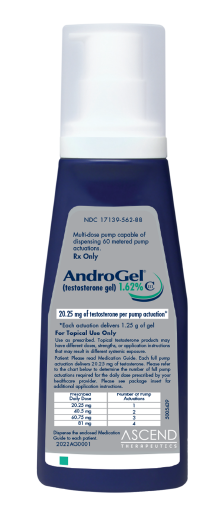
  • AndroGel® (testosterone gel) 1.62% is a prescription medicine used to treat adult males who have low or no testosterone. It is not known if AndroGel 1.62% is safe or effective in children younger than 18 years old.

    Reference: AndroGel® 1.62% [package insert]. North Chicago, IL: Abbott Laboratories.

    Click to view full Prescribing Information, including the Medication Guide, for AndroGel 1.62%.

    • It is important that you apply AndroGel 1.62% exactly as prescribed by your healthcare provider.
    • Your healthcare provider will tell you how much AndroGel 1.62% to apply and when to apply it.
    • Your healthcare provider may change your AndroGel 1.62% dose. Do not change your AndroGel 1.62% dose without talking to your healthcare provider.
    • AndroGel 1.62% is to be applied to the area of the shoulders and upper arms that will be covered by a short-sleeve T-shirt. Do not apply AndroGel 1.62% to any other parts of your body, such as your stomach area (abdomen), penis, or scrotum.
    • Apply AndroGel 1.62% at the same time each morning. AndroGel 1.62% should be applied after showering or bathing.
    • Wash your hands right away with soap and water after applying AndroGel 1.62%.
    • Let the application areas dry for a few minutes before putting on a shirt.
    • Avoid showering, swimming, or bathing for at least 2 hours after you apply AndroGel 1.62%.
    • AndroGel 1.62% is flammable until dry. Let AndroGel 1.62% dry before smoking or going near an open flame.

    Reference: AndroGel® 1.62% [package insert]. North Chicago, IL: Abbott Laboratories.

    Click to view full Prescribing Information, including the Medication Guide, for AndroGel 1.62%.

  • You are encouraged to report negative side effects of prescription drugs to the FDA. Visit www.fda.gov/medwatch, or call 1-800-FDA-1088 (1-800-332-1088).

    If you cannot afford your medication, contact www.pparx.org or call the toll free number (1-888-4PPA-NOW) (1-888-477-2669) for assistance.

    Reference: AndroGel® 1.62% [package insert]. North Chicago, IL: Abbott Laboratories.

    Click to view full Prescribing Information, including the Medication Guide, for AndroGel.